
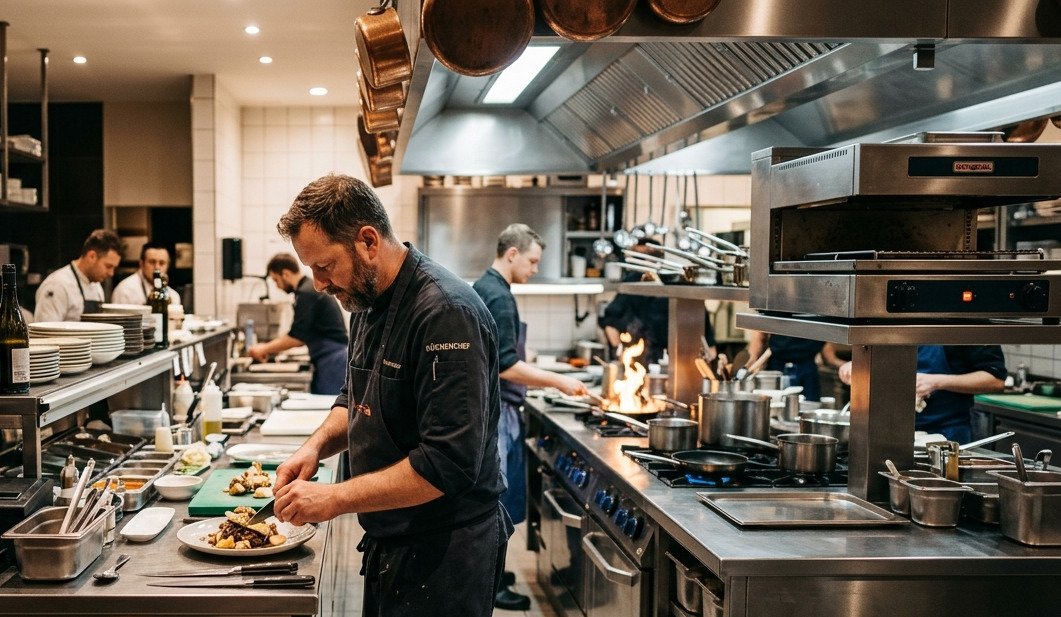
Contents insurance for the catering industry: What restaurants and cafés need to cover


Catering and restaurant businesses are among the industries with an increased risk of fire. Open flames, deep fryers, hot surfaces, and long operating hours significantly increase the potential for damage. In addition, there are burglaries, water damage from dishwashers and cooling systems, and equipment that can quickly add up to six-figure sums in the event of a total loss. For this reason, contents insurance is not an optional add-on for catering businesses, but a central component of business protection.
This guide explains exactly what is covered, where typical gaps occur, and which modules are particularly relevant for restaurants and cafés. These assessments are based on thousands of consultations and real-world claims.

- Coverage includes furnishings, kitchen equipment, and goods in the event of fire, burglary, tap water damage, as well as storm and hail.
- Grease fires and kitchen fires are generally covered. If agreed safety requirements are consistently ignored, the insurer may reduce benefits depending on the individual case.
- Outdoor seating, patio furniture, and refrigerated goods are not automatically covered.
- Many online policies do not automatically cover industry-specific risks such as refrigerated goods, outdoor seating, or sufficiently dimensioned business interruption insurance. That is why it is worth taking a close look at the terms and conditions.
What damages are covered in the catering and restaurant industry?
Commercial contents insurance covers property damage to furnishings, kitchen equipment, appliances, furniture, goods, and inventory caused by five categories of risk:
- Fire: Fire, lightning, explosion. Smoke and soot damage, as well as grease and kitchen fires, are generally included. Benefit restrictions may apply if agreed safety requirements or obligations have been violated.
- Burglary and robbery: Burglary with visible signs of forced entry, robbery, and vandalism in connection with a burglary. Simple theft without signs of forced entry is not covered.
- Tap water: Pipe bursts, frost and thaw damage, water escaping from supply and drainage pipes or connected equipment such as dishwashers and cooling units.
- Storm and hail: Storms from wind force 8 upwards, hail without a minimum wind speed requirement.
- Natural hazards (optional):Flooding, sewer backup, earthquake. These are not included in many basic policies. Coverage is particularly important for businesses in high-risk areas or those with basement spaces.

A restaurant suffered smoke and scorch damage, requiring subsequent fire restoration. Property damage and new equipment costs totaled around 100,000 euros. Because the business remained closed for two and a half months, an additional 70,000 euros in business interruption losses were incurred. Only because both were insured was the business able to continue operating afterward.
What are the specific risks for hospitality businesses?
Compared to other business sectors, the hospitality industry has a structurally higher risk profile, which centers on five key points:
Grease fires are among the most common fire risks in the catering industry. Many insurers link grease fire protection to specific requirements: approved grease fire extinguishing systems and regular cleaning of the exhaust system. If these requirements are not consistently met, the insurer may reduce its payout depending on the individual case.
Outdoor seating and terrace furniture are often not automatically included in insurance coverage. Tables, chairs, patio heaters, and parasols must be actively included as part of outdoor coverage. Anyone who forgets this will find out the hard way after the next storm or burglary.
Refrigerated goods are particularly often forgotten in the catering industry. Spoilage due to power outages or cooling unit defects is not included in standard coverage. Depending on the stock, the loss can quickly reach several thousand euros.
Glass damage to shop windows, glass counters, or display cases is not part of the basic coverage. A separate glass insurance policy is advisable for businesses with large glass surfaces and high customer traffic.
Tap water damage in the catering industry is not just caused by burst pipes. Overflowing grease traps, clogged sewage pipes, or defects in dishwashing and kitchen technology can also cause significant damage to furnishings and goods.
Officially ordered business closures are not automatically part of every business interruption insurance policy. Whether and to what extent coverage exists depends on the tariff and the agreed-upon modules.
Do you know which of these gaps your current contract has?
→ Get a no-obligation review of your coverage now
Which additional modules are useful for catering businesses?
In the catering industry, business interruption insurance is often more economically important than the property damage coverage itself. According to the assessment of the German Insurance Association (GDV), business interruptions often cause higher costs than the actual damage to the building or inventory itself. The reasons for this are long restoration times, ongoing fixed costs, and lost revenue.
Business interruption insurance covers ongoing fixed costs and lost profit as long as the business is partially or fully at a standstill following an insured loss. The indemnity period should be at least 12 months. For complex renovations or longer replacement times, 18 or 24 months may be advisable.
The insurance sum should be calculated based on the actual annual gross profit, i.e., revenue minus variable costs. In many catering businesses, the cost of goods sold is about 30 percent of revenue. The insurance-relevant annual gross profit is therefore often around 70 percent of revenue. For example, if a restaurant generates 1 million euros in annual revenue, the annual gross profit is often around 700,000 euros. The insurance sum for business interruption insurance should be based on this figure, not on the inventory value.
Other useful components include glass insurance, outdoor coverage for terrace furniture, and a refrigerated goods module for spoiled stock following a power outage or cooling system failure. Natural hazard coverage should be considered, especially for businesses in flood or heavy rain zones, as well as for basement-level premises.
Could your business survive several months of downtime?
→ Get a no-obligation review of your business interruption insurance
What should restaurateurs pay special attention to when taking out a policy?
In the catering industry, policy obligations are disproportionately often the deciding factor in whether a claim is paid. Some insurers only cover burglary if cylinder locks protrude no more than 4 millimeters from the strike plate. Anyone who is unaware of such requirements or fails to comply with them consistently risks having their benefits reduced or facing disputes over settlement in the event of a claim.
The insurance sum must reflect the current replacement value of the entire inventory, not the depreciated value or the book value from your balance sheet. This includes not only tables, chairs, and kitchen appliances, but often also custom-made counters, drywall, wall paneling, entrance areas, ventilation and exhaust systems, and decorative fixtures. Especially after renovations, the actual value of the furnishings often increases significantly without the insurance sum being adjusted.
Rule of thumb: Imagine your restaurant was completely empty after a total loss. How much money would you need today to fully rebuild the operation, including the kitchen, furnishings, and all fixtures? Your insurance sum should be based on this replacement value.
An insurance broker who understands the catering industry checks sums and contract terms before you sign, not just when a claim occurs.
Based on 26,000 consultations regarding contents insurance, we know that for businesses founded within the last two years, a typical loss of contents often exceeds available cash reserves. In capital-intensive industries like catering, this can quickly become a threat to the company's survival.
Many catering businesses are underinsured without even knowing it.
→ Have your insurance sum checked now
Catering Business Contents Insurance: The Next Step
For catering businesses, business contents insurance is not a standard product. Grease fire requirements, outdoor seating, refrigerated goods, and business interruption all require a contract that accounts for the actual risks of your operation.
You can find more basics in our guide to commercial contents insurance.
An online calculator can provide a rough initial orientation. However, it is usually not sufficient for reliable coverage. It cannot accurately evaluate the actual value of your inventory, industry-specific risks, or important policy details.
VersicherungsEngel connects you with brokers specializing in the catering industry. They don't just check premiums and benefits; they also assess potential coverage gaps, industry-specific risks, and the adequacy of your insurance sums.
Request a personal consultation and have your coverage reviewed.
Good questions deserve good answers.
The questions we hear most — answered in plain English.
Frequently asked questions about business contents insurance for the catering industry
Yes. Grease fires and kitchen fires are generally covered, provided it is an insured fire loss and there have been no breaches of policy obligations relevant to the claim.
Refrigerated goods are not included in the standard scope of many policies. Damage caused by power outages or cooling system failure can often be covered via a separate module.
Outdoor seating is usually not covered automatically. Tables, chairs, sun umbrellas, or patio heaters often require additional coverage through an outdoor insurance extension.
Questions about D&O insurance
D&O insurance starts at roughly €500–€1,500 per year for smaller companies, and can run into five figures for larger organisations. However, the cost of your D&O insurance depends largely on the following factors:
- Company size & turnover:The bigger your company, the higher the risk.
- sector:In highly regulated or high-risk industries (such as finance or construction), you pay more on average.
- Coverage amount:The higher the coverage amount (e.g., €1 million vs. €10 million), the more expensive the policy.
- Number of insured persons:If your D&O insurance covers not only you but also other board members or managing directors, this will result in higher costs.
- Individual risk assessment:Does your company have a history of lawsuits or claims?
The bottom line: the cost of D&O is always lower than the cost of personal liability.
Because a good D&O protects your private wealth and therefore also your future in an emergency, it is always worthwhile. However, our insurance angels will also find the best price for you on top.
Yes. Although GmbH stands for "Gesellschaft mit beschränkter Haftung" (limited liability company), that protection only applies to claims directed at the company itself — not to you personally as a director.
Your GmbH is sufficient as protection if...
- Your company causes damage, such as a product defect or a breach of contract.
- Customers or business partners assert claims against the GmbH, not against you personally.
- As managing director, you have acted to the best of your knowledge and belief without any breach of duty.
The GmbH does NOT protect you if...
- You are held personally liable for incorrect decisions, e.g., due to delayed insolvency filing, tax errors, or gross negligence.
- Shareholders, authorities, or investors sue you.
- you are accused of one or more of the breaches of duty mentioned above.
The insurance company may decide not to pay in the following cases:
1. If the damage resulted from a business decision made without any breach of duty.
Example: a CFO invests millions in a project without a risk analysis — despite warnings from the finance team. The insurer pays. But if a CFO makes a carefully considered strategic decision that fails due to unpredictable market conditions, the insurer does not pay.
2. When the board member acted intentionally — for example, in cases of fraud or deliberate violations of the law.
3. If the agreed coverage amount is not sufficient..
If a CEO is held liable for €10 million in damages but only has €5 million in coverage, the difference comes out of their personal assets.
In short: D&O protects you against negligent mistakes — provided your coverage is adequate. It does not cover intentional misconduct or policies that are too low. That's exactly why professional, personalised advice matters — which is what your Insurance Angel is there for.
Yes — D&O insurance typically remains valid for several years after you leave your position, provided the claim relates to a decision made during your time in office.
Yes — even in a voluntary capacity, you can face personal liability for wrong decisions. For example, if you sign contracts that cause financial harm to the organisation.
Beyond protecting you personally, a good D&O policy can also cover part or all of the actual damage caused by your mistake.
Example: Stefan, managing director of an engineering firm, invests €5 million in a new production line — without adequate due diligence. The equipment doesn't work and the company loses €3 million. Shareholders sue Stefan personally. His D&O policy covers his personal liability as well as a portion of the resulting business losses.
When recommending a policy, your Insurance Angel makes sure it covers not just you, but potential damage to the company as well.
Yes and no. A good D&O policy addresses reputational damage — but only indirectly.
D&O itself does not compensate for lost revenue or a damaged reputation. However, additional coverage options exist that cover crisis management costs, such as PR consultants, mediators, or reputation agencies — all of which help limit the damage.


About the author:
Lion Dahlenburg is the Managing Director of VersicherungsEngel and has been working in the insurance industry for over eight years. His areas of expertise include commercial insurance, risk management, sales strategies, and the digitalization of the sector. He has focused on these topics throughout his career, starting with four years at Allianz, followed by helping to build a Berlin-based InsurTech company for digital commercial insurance, where he established and led sales and customer service from the ground up.
During this time, he has personally acquired and supported over 1,000 corporate clients—a wealth of experience that informs his work today. With VersicherungsEngel, he and his team help around 2,000 companies every month find the right contact for their insurance and coverage needs. As an industry expert, he has been quoted as an interviewee by publications including the trade journal Versicherungswirtschaft heute.
Lion’s professional expertise is built on a degree in Business Administration with a focus on insurance, a Master’s degree in Business Consulting & Digital Management, and several IHK certifications in insurance, financial investments, and real estate loans.
Qualifications at a glance:
- B.A. in Business Administration (specializing in insurance) and a Master's degree in Business Consulting & Digital Management
- IHK-certified insurance specialist, financial investment specialist, and real estate loan broker
- Over 650 positive reviews on Trustpilot, Google, and eKomi, as well as more than 3,500 LinkedIn followers